

High Ticket Affiliate Marketing: The Complete Beginner's Guide (2026)
What if you could earn the same income from 3 sales a month that most affiliates grind for with 300?
That is the core promise of high ticket affiliate marketing - and it is why thousands of creators, bloggers, and side-hustlers are quietly walking away from $4 commissions in favor of programs that pay $500, $1,000, or even $5,000 per referral.
But high commissions also come with more questions. What is high ticket affiliate marketing, really? Is it legit, or is it a repackaged pyramid scheme? Which niches actually pay? And can a complete beginner with no audience realistically make it work in 2026?
This high ticket affiliate marketing guide answers all of that. Whether you are starting from zero or switching from low-ticket products, you will get a plain-English breakdown of how the model works, the best niches and programs, proven traffic strategies, realistic earnings, and the mistakes that quietly kill beginner accounts.
This is written specifically as high ticket affiliate marketing for beginners - no prior experience, audience, or budget assumed. By the end you will know exactly what to do first, what to avoid, and how to think about the numbers realistically instead of chasing hype. Let’s get into it.
Quick context: The global affiliate marketing market is projected to pass $20 billion in 2026, and over 90% of e-commerce brands are expected to run affiliate programs by the end of the year. High ticket is simply the most profitable slice of that pie.
What Is High Ticket Affiliate Marketing?

High ticket affiliate marketing is the practice of promoting expensive, high-value products or services and earning a large commission - typically $100 or more per sale, and often several hundred to several thousand dollars - each time someone buys through your referral link.
Here is the simplest high ticket affiliate marketing definition you will find: instead of earning small commissions on cheap products, you earn big commissions on premium ones.
The “ticket” refers to the price of the product. A $7 ebook is a low ticket. A $3,000 coaching program, a $5,000 enterprise software contract, or a $25,000 private jet charter is a high ticket. You are still doing the same fundamental job - recommending a product and getting paid when someone buys - but the math behind every sale is dramatically different.
To put the meaning of high ticket affiliate marketing in one line: it is a volume-light, value-heavy business model where a handful of well-placed sales can outperform thousands of low-value transactions.
A quick analogy. Low ticket affiliate marketing is like running a coffee shop - small margins, so you need a constant stream of customers all day to do well. High ticket is more like being a real-estate agent - you might close only a few deals a month, but each one pays enough to make the whole month worthwhile. You are doing the same fundamental job of selling; the reward per transaction is just on a different scale.
How It Differs From Traditional Affiliate Marketing
Traditional (low ticket) affiliate marketing usually means promoting inexpensive physical or digital products - think Amazon items, $20 plugins, or $10/month tools - where commissions range from a few cents to maybe $50. To build a real income, you need huge traffic and a high volume of sales.
Here is high ticket affiliate marketing explained by contrast:
- Fewer sales, bigger payouts. One high ticket sale can equal hundreds of low ticket ones.
- Trust over traffic. Success depends more on audience trust and buyer intent than on raw pageviews.
- Longer sales cycles. Expensive purchases require more research, so the buyer journey is longer and more relationship-driven.
- Recurring potential. Many high ticket programs (especially SaaS) pay recurring commissions for the lifetime of the customer, not just once.
In short: low ticket is a volume game; high ticket is a value game.
Real-World Examples
A few concrete examples make the model click:
- SaaS: Promote HubSpot and earn 30% recurring commission for up to 12 months - an Enterprise referral can generate $250–$1,000+ per customer.
- Web hosting: Refer a customer to Kinsta and earn up to $500 upfront plus 5% recurring monthly.
- Online education: Recommend a $997 course and earn around $400 per enrollment.
- Luxury travel: Refer a private-jet booking through Villiers Jets and earn 30% - often $1,000+ on a single flight.
- Finance: Refer customers to premium investing, trading, or business-credit platforms and earn $100–$500+ per qualified signup, with some offers paying considerably more.
Same skill set. Wildly different paychecks. That is the appeal of high ticket affiliate marketing.
How Does High Ticket Affiliate Marketing Work?

The mechanics are identical to any affiliate program. The difference is in the numbers - and in how much intentionality each sale requires. Here is the full loop, broken down.
Affiliate Commissions Explained
When you join a high ticket affiliate program, you receive a unique tracking link (and often a cookie that lasts 30–90 days). The flow looks like this:
- You share your link in a blog post, video, email, or ad.
- A reader clicks it, and a cookie is stored in their browser.
- They buy the product - sometimes immediately, sometimes weeks later.
- The platform attributes the sale to you and credits your commission.
- You get paid out on the program’s schedule (weekly, monthly, or net-30/60).
High ticket commissions come in three common shapes:
- Flat-fee bounties - e.g., a fixed $500–$2,000 per qualified sale (common for hosting and enterprise software).
- Percentage commissions - typically 10%–50% of the sale price (common in courses, luxury goods, and travel).
- Recurring commissions - a percentage paid every month the customer stays subscribed (the holy grail of SaaS; e.g., Systeme(.)io pays 60% for life).
Two terms quietly decide whether you actually get paid: the cookie window and the attribution model. The cookie window is how long after a click you can still earn credit - 30 to 90 days is common in high ticket, and longer is better because expensive purchases take time to decide on. Attribution determines who gets credit when a buyer clicks several links; most programs use last-click. Always check both before promoting, because they directly affect how much of your work converts into paid commissions.
Sales Funnels
Because high ticket buyers rarely purchase on impulse, most successful affiliates rely on a sales funnel - a deliberate path that warms a stranger into a buyer. A typical high ticket funnel looks like:
Awareness (blog post, YouTube video, or ad) → Interest (lead magnet or email opt-in) → Consideration (comparison content, case studies, demos) → Decision (your affiliate link, often with a bonus or urgency) → Purchase.
You are not just dropping a link and hoping. You are guiding someone through a decision they want to get right because they are spending real money. You do not need expensive software to build one, either - a single blog post, a free downloadable guide offered in exchange for an email, and a short follow-up sequence already make a complete starter funnel.
Customer Journey
The high ticket customer journey is longer and more research-heavy than low ticket. A buyer comparing $3,000 software will read reviews, watch tutorials, ask in communities, and sign up for trials before committing.
Your job is to be present and genuinely helpful at every one of those touchpoints - answering objections, comparing alternatives honestly, and demonstrating real value. The affiliate who becomes a trusted guide (not just a link-dropper) is the one who earns the commission. This is exactly why content quality and authority matter so much more in high ticket than in low ticket.
Picture a small-business owner choosing a $3,600-a-year marketing platform. They might read your in-depth review in week one, watch your setup tutorial in week two, join your email list for a comparison guide, and finally buy in week four after you answer their last objection. Five touchpoints, one commission - and every touchpoint was a chance to build (or lose) the trust that closed the sale.
High Ticket vs Low Ticket Affiliate Marketing
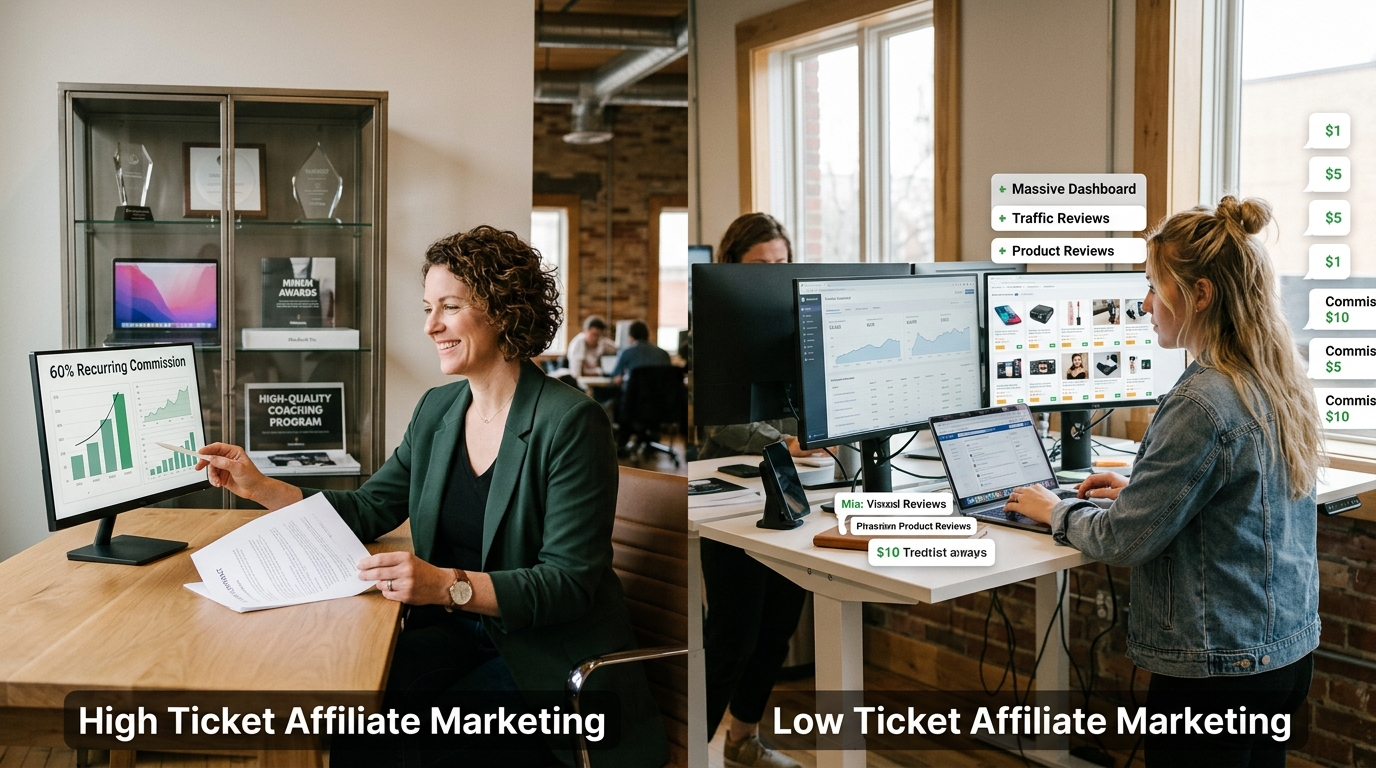
Neither model is “better” in the abstract - they suit different goals, audiences, and personalities. Here is a side-by-side comparison.
Comparison Table
| Factor | High Ticket Affiliate Marketing | Low Ticket Affiliate Marketing |
|---|---|---|
| Typical product price | $500 – $25,000+ | $5 – $200 |
| Commission per sale | $100 – $10,000+ | $1 – $50 |
| Sales needed for ~$10k/month | 3 – 20 | 500 – 5,000 |
| Sales cycle | Longer, trust-based | Short, often impulse |
| Traffic required | Lower (quality over quantity) | High (volume-driven) |
| Conversion rate | Lower per visitor | Higher per visitor |
| Audience trust needed | High | Low |
| Recurring income potential | Common (especially SaaS) | Rare |
| Impact of one refund | Significant | Negligible |
| Best suited for | Authority builders, niche experts | High-volume publishers, broad sites |
Pros and Cons
High ticket - pros: larger commissions, fewer sales required, strong recurring potential, higher ROI on your time, easier to hit big income goals with a small audience.
High ticket - cons: longer sales cycles, lower conversion rates, more trust and content required upfront, and a single refund or chargeback stings more.
Low ticket - pros: easier and faster first sales, more forgiving of mistakes, great for learning the fundamentals, works with cold/broad traffic.
Low ticket - cons: you need enormous traffic to earn meaningfully, commissions are tiny, and the income ceiling is hard to break without massive scale.
In practice, the right choice comes down to your strengths. If you can create in-depth, trustworthy content, high ticket rewards it richly. If you are better at producing high volumes of content and reaching huge audiences, low ticket can still add up.
Which Model Is Best?
For most people who want a real income without becoming a media empire, high ticket wins on efficiency - your effort per dollar earned is far lower. That said, many successful affiliates run a hybrid: low ticket products build the email list and trust, while high ticket offers monetize that audience.
If you are a beginner choosing one to focus on, high ticket is worth committing to if you are willing to invest in content quality and trust-building rather than chasing quick wins. Either way, the core skills transfer - so starting with low ticket and graduating to high ticket later is a perfectly valid path.
Is High Ticket Affiliate Marketing Legit?

Short answer: yes, high ticket affiliate marketing is 100% legitimate. It is a standard, widely-used performance marketing model. Major, reputable companies - HubSpot, Shopify, Semrush, Kinsta, and thousands more - run high ticket affiliate programs because it is an efficient way to acquire customers. You only get paid when you deliver real sales, which is about as honest as business models get. The model has existed for decades; “high ticket” simply describes the price band of what you choose to promote.
That said, the space attracts hype, so it pays to know what is real and what is not.
Common Misconceptions
- “It’s get-rich-quick.” No. It is a real business that rewards skill, consistency, and trust-building over months - not days.
- “You need a huge audience.” Not necessarily. Because payouts are large, a small, highly targeted audience can be enough.
- “It’s only for influencers.” False. Plenty of high earners are anonymous bloggers, YouTubers, or email marketers who simply solve a specific problem well.
- “All the good programs are taken.” Not true. New high ticket products launch constantly across SaaS, courses, and services - there is always room for a helpful, trusted voice.
Pyramid Scheme Concerns
A frequent fear is that high ticket affiliate marketing is “just a pyramid scheme.” It is important to understand the difference:
- Legitimate affiliate marketing: You earn commission for selling a real product or service that has value on its own. You are paid by the merchant, not by recruiting other people.
- Pyramid / illegal MLM schemes: Income comes primarily from recruiting other members who pay to join, rather than from selling a genuine product to end customers.
The litmus test: Where does the money come from? If you are paid for selling a real product people actually want, it is legitimate affiliate marketing. If you are mostly paid for recruiting others into the “opportunity” itself, walk away. Reputable high ticket programs from companies like HubSpot, Shopify, or Kinsta simply pay you to bring them customers - there is nothing to “buy in” to and no downline to recruit.
Red Flags to Avoid
Be cautious of any “high ticket” program that:
- Requires a large upfront fee just to become an affiliate or “unlock” commissions.
- Focuses on recruiting affiliates rather than selling a real product.
- Promises guaranteed or “passive” five-figure income with no work.
- Has a vague, low-value product that exists mainly to justify the commission.
- Uses high-pressure, countdown-timer tactics and refuses to show real customer results.
- Hides its commission structure or payout terms until after you pay.
Stick to programs tied to established products with genuine demand, and you will steer clear of the bad actors.
Why People Choose High Ticket Affiliate Programs

So why are experienced marketers increasingly drawn to high ticket offers? It comes down to three powerful advantages.
Higher Commissions
This is the obvious one. Earning $500–$5,000 per sale changes the entire economics of your business. A blog post that converts a single high ticket sale can out-earn a low ticket article that gets ten times the traffic. Your content, your email list, and your time all become far more valuable. It also lets you be selective: because you only need a few great products to build a real income, you can promote things you genuinely believe in instead of plastering links everywhere.
Fewer Sales Required
To earn $10,000 a month selling a $20 product at a $4 commission, you would need 2,500 sales. With a high ticket offer paying $1,000 per sale, you need just 10. Fewer sales means fewer customer touchpoints, less support overhead, and far less traffic pressure - which is enormous relief for solo creators and beginners. It also makes your business less fragile: you are not dependent on a constant flood of visitors just to stay afloat.
Better ROI
Across the industry, affiliate marketing already delivers a strong return - roughly $12–$15 back for every $1 spent. High ticket pushes that ROI even further because the same piece of content, ad spend, or email sequence can generate a much larger payout. When your cost to produce content is fixed but your reward per conversion multiplies, your return on time and money climbs sharply. That efficiency is the real reason high ticket has become the model of choice for serious affiliates in 2026. And with the global affiliate market projected to pass $20 billion in 2026 and over 90% of e-commerce brands running affiliate programs, there has rarely been more high ticket inventory to choose from.
How to Start High Ticket Affiliate Marketing

Here is a clear, beginner-friendly roadmap. Follow these six steps in order and you will have a real foundation rather than a random collection of links. None of them require special connections or a big budget - just consistency. Work through them in sequence, and resist the urge to skip ahead to traffic before you have something worth sending traffic to.
Step 1: Choose a Niche
Your niche is the foundation of everything. Pick one that is (a) profitable - it has expensive products with affiliate programs, (b) interesting to you - you will create a lot of content, so genuine interest matters, and © has buyer intent - people actively spend money to solve problems in it.
Avoid going too broad (“make money online”) or too narrow (“left-handed accountants in Ohio”). Aim for a focused but viable space like “email marketing software for coaches” or “luxury solo travel.” We will cover the best high ticket niches in detail below. If you are stuck, start from what you already know or use: the tools, courses, or services you have personally paid for are usually the easiest to recommend convincingly. Before you commit, do a quick demand check: are people actively searching for solutions in this space, and are there at least a few programs paying $100+ per sale? If yes, it is viable.
Step 2: Find Affiliate Programs
Once you have a niche, find the high ticket programs within it. Look for programs that pay $100+ per sale, ideally with recurring commissions and a reasonable cookie window (30–90 days). You can find them by:
- Searching “[your niche] affiliate program” and “[competitor product] affiliate.”
- Browsing affiliate networks and marketplaces.
- Checking the footer of the products you already use and love.
- Asking in niche communities and noting what other creators in your space promote.
Always read the terms: commission rate, payout threshold, cookie duration, and whether they allow paid ads or branded-keyword bidding. As a rule of thumb, favour programs run on dedicated affiliate software (like HeldSway), covered below) - professional tracking and reliable, on-time payouts mean your hard-earned commissions actually get counted and paid. Where available, check the program’s average earnings-per-click (EPC) and conversion rate too - they tell you how well an offer actually converts before you invest time promoting it.
Step 3: Build a Website
A website (or at minimum a content hub you control) is your home base. It builds authority, ranks in search, captures emails, and houses the in-depth content high ticket buyers need. A simple WordPress site with a clean theme, an about page, a few cornerstone articles, and clear affiliate disclosures is plenty to start.
Owning your platform matters: social accounts can be banned overnight, but your website and email list are assets you control. You do not need design skills or a big budget - a clean, basic site can be live in a weekend, and you can always upgrade the look later. What matters first is publishing helpful content and capturing emails.
Step 4: Create Content
Content is how you earn trust and rank in search. For high ticket, focus on high-intent, decision-stage content that helps buyers make confident choices:
- In-depth product reviews (honest, with pros and cons).
- Comparison posts (“Product A vs Product B”).
- “Best [product] for [use case]” roundups.
- Tutorials and case studies showing the product in action.
- Buyer’s guides that address objections and questions.
Quality beats quantity here. A handful of genuinely helpful, well-researched articles will outperform fifty thin ones. For example, one thorough “[Product] review: is it worth it in 2026?”, a “[Product] vs [Competitor]” comparison, and a “how to get started with [Product]” tutorial together form a small content cluster that catches buyers at every stage of their decision.
Step 5: Drive Traffic
Content needs an audience. The main traffic channels (covered in depth later) are SEO, YouTube, email marketing, paid ads, and social/personal branding. Beginners should usually pick one or two channels and get good at them rather than spreading thin. SEO and YouTube are popular for high ticket because they reach people actively researching a purchase. Whichever you choose, commit to it for at least 90 days before judging results - most channels take time to gain traction, and constant channel-hopping is a common reason beginners stall.
Step 6: Optimize Conversions
Traffic without conversions is just expensive applause. Improve your conversion rate by:
- Adding clear, benefit-driven calls to action.
- Offering bonuses (a checklist, template, or consult) for buying through your link.
- Using comparison tables and honest recommendations to reduce decision friction.
- Building an email sequence that nurtures leads over time.
- A/B testing headlines, CTAs, and placements.
Then track everything. Knowing which content and which links produce sales is what lets you double down on what works - and it is exactly the kind of tracking a dedicated affiliate platform handles for you. Even small tweaks compound: moving a call-to-action higher, adding a comparison table, or answering one more objection can lift conversions enough to noticeably change your monthly income.
Best High Ticket Affiliate Marketing Niches

Not all niches are created equal. These six consistently offer expensive products, strong demand, and generous commissions in 2026.
1. SaaS (Software as a Service)
The sweet spot of high ticket. SaaS programs frequently pay 20%–70% recurring commissions, meaning you earn every month the customer stays subscribed. Examples include HubSpot (30% recurring up to 12 months), ClickFunnels (up to 40% recurring), and Systeme(.)io (60% for life). Because businesses rely on software long-term, churn is low and lifetime value is high - ideal for building predictable, compounding income.
2. Finance
Investing platforms, trading tools, business credit, crypto services, and premium financial education routinely pay large commissions because customer lifetime value is enormous. Trust and compliance matter most here, so accurate, responsible content wins. Typical payouts run from $100 to $500+ per qualified referral, and some investing or business-credit offers pay considerably more. (Always follow disclosure rules and avoid giving specific financial advice.)
3. Education
Online courses, coaching programs, and certifications regularly sell for $500–$5,000+, with affiliate commissions of 30%–50%. A single $2,000 course referral at 40% earns you $800. Platforms like Teachable and high-end course creators offer strong programs, and the e-learning market keeps expanding. Coaching and certification programs convert especially well because buyers are investing in an outcome - a new skill or career - and will pay a premium on the strength of a credible recommendation.
4. Luxury Products
High-end watches, jewelry, fashion, home goods, and electronics carry premium price tags, so even a modest percentage commission becomes substantial. These convert best with aspirational, visually-rich content and an audience that trusts your taste. On a $10,000 watch, even a modest 10% commission is $1,000 from a single sale.
5. Health & Wellness
Premium supplements, fitness equipment, coaching, biohacking devices, and wellness retreats command high prices and loyal, repeat buyers. This evergreen niche performs especially well with personal, results-driven content - but keep claims honest and compliant. Premium programs and high-end equipment can pay $100–$1,000 per sale, and recurring supplement subscriptions add a steady monthly layer on top.
6. Travel
Luxury travel is a standout high ticket niche. Private jet charters, yacht rentals, luxury tours, and premium booking services can pay $1,000+ per booking. Villiers Jets, for example, pays 30% on charter flights. Travel content also lends itself perfectly to YouTube and visual storytelling, and a single luxury booking can out-earn a full month of low-ticket content.
Best High Ticket Affiliate Marketing Programs

Once you have picked a niche, you will join specific programs. Here are some of the most reputable high ticket affiliate programs in 2026, across categories:
| Program | Category | Typical Payout |
|---|---|---|
| HubSpot | SaaS / Marketing | 30% recurring up to 12 months ($250–$1,000+ per Enterprise customer) |
| Shopify | E-commerce | Bounties up to ~$2,000 depending on plan |
| BigCommerce | E-commerce | 200% of first month, or up to $1,500 per Enterprise sale |
| Systeme(.)io | SaaS / Funnels | 60% recurring for the lifetime of the customer |
| ClickFunnels | SaaS / Funnels | Up to 40% recurring monthly |
| Kinsta | Web hosting | Up to $500 upfront + 5% recurring monthly |
| WP Engine | Web hosting | $200 minimum or 100% of first month (whichever is higher) |
| Semrush | SaaS / SEO | $200 per subscription sale |
| Teachable | Education | Up to 30% recurring |
| Villiers Jets | Luxury travel | 30% per booking (often $1,000+) |
Commission terms change - always confirm the current rates on each program’s official page before promoting.
The Other Side of the Coin: Run Your Own Program With HeldSway
Everything above is about promoting other companies’ products. But here is what many high ticket marketers realize sooner or later: the real leverage is being on the other side - the brand that runs the program and has an army of affiliates selling for you.
If you sell a high ticket product, course, SaaS, or service, launching your own affiliate program turns your customers and fans into a commission-only sales force. The catch is the operations: tracking every click and sale accurately, calculating commissions across different rules, and paying affiliates on time. Try to do that with spreadsheets and it falls apart fast.
That is exactly what HeldSway is built for. It is an affiliate-management platform (built by Leaping Logic) that lets growing brands launch, manage, and scale an affiliate program - connecting your business with your affiliates in one place and automating the three things that matter most:
- Tracking - real-time click and conversion tracking, coupon-code tracking, cross-device attribution, and first-party/cookieless tracking that survives ad blockers and browser privacy updates, with fraud filters and full audit trails.
- Commissions - flat, percentage, recurring, lifetime, performance-based tiers, multi-tier, and per-product rules. Ideal for high ticket and recurring SaaS payouts: set the rules once and HeldSway handles the math.
- Payouts - scheduled PayPal and ACH runs, tax-form collection (W9/W8), 1099 filing, and audit-ready history, so affiliates get paid reliably and you stay compliant.
Your affiliates get a white-label portal on your own domain with their links and real-time stats, and you get one-click installs for Shopify, WooCommerce, WordPress, and Stripe (plus Zapier and a REST API for everything else). Pricing is refreshingly transparent: a pay-as-you-go plan from $0/month (you only pay a small percentage of what you actually pay out), flat plans from $19/month, and a 30-day free trial with no credit card required.
So whichever side of high ticket affiliate marketing you are on, the operational layer is covered. As an affiliate, the best programs to join are the ones run on solid platforms - accurate tracking and on-time payouts protect your commissions. And when you are ready to run your own high ticket program, HeldSway is how you launch it without the engineering or the spreadsheets.
Tip: If you already have a high ticket offer, you can have a program live in a single afternoon - connect your store, set your commission rules, share your signup page, and let HeldSway handle tracking and payouts from there.
High Ticket Affiliate Marketing Strategies

Joining programs is the easy part. These five strategies are how you actually generate consistent high ticket sales.
SEO (Search Engine Optimization)
SEO is arguably the best long-term channel for high ticket because it captures people at the exact moment they are researching a purchase. Target high-intent, “bottom of funnel” keywords like “best [product] for [use case],” “[product] review,” and “[product A] vs [product B].” These searchers are ready to buy - they just need help deciding.
Build topical authority with clusters of related content, earn backlinks, optimize for on-page basics, and be patient: SEO compounds over 6–12 months into a traffic engine that costs nothing per click. A single well-ranked “best [software] for [use case]” article can quietly generate high ticket sales every month for years.
Email Marketing
Email is the highest-ROI channel in affiliate marketing, and it is perfect for high ticket because expensive purchases need nurturing. Offer a valuable lead magnet to capture emails, then run a sequence that educates, builds trust, handles objections, and presents your offer over time. Because you own the list, you can promote multiple high ticket offers to the same audience for years. A simple 5–7 email welcome sequence that teaches something genuinely useful, then recommends your main offer, is enough to start earning.
YouTube
Video builds trust faster than almost any other medium - and trust is the currency of high ticket. Tutorials, honest reviews, comparisons, and “how I use [product]” videos let buyers see the product in action. YouTube doubles as the world’s second-largest search engine, so well-optimized videos keep earning long after you publish. Put your affiliate links in the description with clear disclosure. “X vs Y” and honest “after 6 months with [product]” videos convert especially well because they reach buyers right at the decision stage.
Paid Ads
Paid traffic (Google, YouTube, Meta, native ads) can accelerate results because high commissions give you room to profitably pay for clicks. But it carries real risk: you can lose money fast if your funnel does not convert. Beginners should start small, track ROI obsessively, and only scale what is provably profitable. Note that some programs restrict paid or branded-keyword ads - always check the terms first. A safer starting point: send paid traffic to a free lead magnet, capture the email, and let your sequence do the selling, rather than paying to send cold clicks straight to an affiliate link.
Personal Branding
People buy from people they trust. Building a personal brand - consistent presence on a platform, a recognizable point of view, and genuine helpfulness - makes every other strategy work better. When your audience sees you as a credible expert in your niche, your recommendations carry weight, and high ticket conversions follow naturally. Pick one platform, post consistently, and share real results and lessons - credibility compounds the same way content does.
The winning move for beginners: pick one primary channel (often SEO or YouTube), add email to capture and nurture leads, and layer in the rest as you grow.
How Much Can You Earn?

This is the question everyone asks. The honest answer: earnings vary enormously based on niche, traffic, and skill - but the ceiling in high ticket is genuinely high. Two affiliates in the same niche can earn wildly different amounts depending on how well they build trust and choose offers, so treat the ranges below as guideposts, not guarantees. Let’s look at realistic numbers.
Earnings Examples
- Beginner (months 1–6): Often $0–$1,000/month. This is the learning and trust-building phase - most people earn little at first, and that is normal.
- Intermediate (months 6–18): Roughly $1,000–$10,000/month as content ranks, the email list grows, and conversions improve.
- Advanced (18+ months): $10,000–$50,000+/month is achievable for those who build authority and scale traffic, especially with recurring SaaS commissions stacking up.
Commission Calculations
The math is what makes high ticket so appealing. To reach $10,000/month:
- At a $1,000 commission per sale → just 10 sales/month (about one every three days).
- At a $500 commission → 20 sales/month.
- Compare that to a $25 low ticket commission → you would need 400 sales/month.
Now add recurring commissions. If you refer 10 SaaS customers a month at $100/month recurring, by month 12 - assuming low churn - you could be earning over $10,000/month from referrals you made throughout the year, not just this month. Here is how that stacking looks (simplified, ignoring churn):
| Month | New customers | Active customers | Monthly recurring income |
|---|---|---|---|
| 1 | 10 | 10 | $1,000 |
| 3 | 10 | 30 | $3,000 |
| 6 | 10 | 60 | $6,000 |
| 12 | 10 | 120 | $12,000 |
The work each month stays the same - but your income climbs because past referrals keep paying. Real numbers will be lower once churn is factored in, but the direction holds, and that compounding effect is the real magic of high ticket SaaS.
Realistic Expectations
A few honest truths to keep you grounded:
- It is not passive at first. The income can become semi-passive, but only after you have built content and systems. Expect to work hard for months before meaningful returns.
- Most beginners quit too early. Results typically come after 6–12 months of consistent effort. The ones who win are simply the ones who do not stop.
- No income is guaranteed. Anyone promising certain riches is selling hype. Treat high ticket as a real business with real timelines.
- Recurring beats one-time. Prioritizing programs with recurring commissions builds a far more stable, compounding income over time.
Set the expectation of a 6–12 month build, focus on serving your audience, and let the large commissions do the heavy lifting. Treat the early months as paid education - every article, video, and email is an asset that keeps working long after you publish it.
Common Mistakes Beginners Make

Avoid these and you will be ahead of most people who try high ticket affiliate marketing:
- Chasing commissions over fit. Promoting a product just because it pays well - even though it does not fit your audience - destroys trust and conversions. Recommend what genuinely helps.
- Promoting products they have never used. Authenticity sells high ticket. If you cannot speak credibly to a product, your content falls flat.
- Expecting fast results. Quitting at month two is the number-one killer of affiliate income. High ticket rewards patience.
- Relying on a single traffic source. Algorithm changes or account bans can wipe you out. Diversify over time, and prioritize assets you own (website, email list).
- Ignoring email. Most high ticket sales happen after multiple touchpoints. No list means leaving most of your money on the table.
- Skipping disclosures. Affiliate disclosures are legally required and build trust. Always disclose clearly.
- Creating only low-intent content. Pure informational content earns traffic but few sales. Balance it with decision-stage, buyer-focused content.
- Not tracking what works. If you do not know which links and pages convert, you cannot improve. Use a platform that gives you unified tracking across every program.
- Spreading too thin. Joining 20 programs and a dozen platforms on day one leads to burnout. Start focused, then scale.
- Treating it like a hobby. The people who earn real money treat high ticket affiliate marketing like the business it is - with goals, systems, and consistency.
- Neglecting mobile readers. Most affiliate traffic and conversions now happen on phones - if your content and calls-to-action are not easy to read and tap on mobile, you lose sales before you even make your case.
Final Words
High ticket affiliate marketing is one of the most efficient online business models available in 2026 - not because it is easy, but because it rewards your effort generously. Instead of chasing thousands of tiny commissions, you build trust with a focused audience and earn substantial payouts from a relatively small number of sales.
For beginners, the path is clear: pick a profitable niche, join reputable high ticket programs, create genuinely helpful decision-stage content, drive targeted traffic through SEO, YouTube, and email, and optimize relentlessly for conversions. Stay patient through the 6–12 month build, avoid the common mistakes, and keep your operations simple by managing everything in one place.
And do not forget there are two ways to win at high ticket: you can promote great programs, or you can run one. The day you launch your own high ticket offer, a platform like HeldSway lets you stand up a fully-tracked, auto-paying affiliate program in an afternoon - turning your own customers into a high-commission sales force. Whichever side you are on, keep the operations simple so you can focus on what actually grows income: creating great content and building trust.
Start small, stay consistent, and let the high commissions compound. Your first high ticket sale is closer than you think.
Frequently Asked Questions
What is high ticket affiliate marketing?
High ticket affiliate marketing is the practice of promoting expensive, premium products or services and earning large commissions - usually $100 or more per sale, and often several hundred to several thousand dollars. Instead of relying on high volumes of small sales, you earn big payouts from a smaller number of high-value referrals.
Is high ticket affiliate marketing legit?
Yes. It is a standard, legitimate performance marketing model used by major companies like HubSpot, Shopify, and Semrush. You are paid a commission for selling real products that have genuine value. It is only problematic when a "program" focuses on recruiting affiliates rather than selling a real product - that is a red flag for a pyramid scheme, not legitimate affiliate marketing.
How much can a beginner earn with high ticket affiliate marketing?
Most beginners earn little to nothing in the first few months while building content and trust. With consistent effort, many reach $1,000–$10,000/month within 6–18 months, and experienced affiliates can earn $10,000–$50,000+/month. Because commissions are large, you need far fewer sales - sometimes just 10 sales a month to reach $10,000.
Do I need a website to start?
It is highly recommended. A website builds authority, ranks in search engines, captures emails, and houses the in-depth content high ticket buyers need. It is also an asset you own and control, unlike social media accounts. You can supplement it with YouTube, email, and social channels.
High ticket vs low ticket - which is better for beginners?
Low ticket is easier for fast first sales and learning the basics, but the income ceiling is low without massive traffic. High ticket requires more trust and patience but is far more efficient per sale. Many affiliates use a hybrid: low ticket and free content to build an audience, then high ticket offers to monetize it.
What is the best high ticket niche for beginners?
SaaS is often the best starting point because of recurring commissions and steady demand. Education (online courses) and web hosting are also beginner-friendly. The best niche for you is one that is profitable, has buyer intent, and genuinely interests you - since you will be creating a lot of content about it.
How long does it take to make the first sale?
It varies, but with consistent, high-quality content most beginners see their first high ticket sale within 3–9 months. SEO and trust take time to build, so the affiliates who succeed are the ones who keep going through the slow early phase.
Can I start my own high ticket affiliate program?
Yes - and for many brands it is the most profitable move of all. If you sell a high ticket product, course, or SaaS, you can recruit affiliates to promote it and pay them only for results. A platform like <a href="https://heldsway.com" target="_blank" rel="noopener noreferrer">HeldSway</a> lets you launch a program in an afternoon: connect your store (Shopify, WooCommerce, WordPress, or Stripe), set commission rules (flat, percentage, recurring, or multi-tier), give affiliates a branded portal, and automate tracking and payouts. It starts at $0/month pay-as-you-go with a 30-day free trial and no credit card, so it is realistic even when you are launching your first offer.