

Affiliate Marketing Compliance Guide (2026) - Rules & Monitoring
Affiliate marketing compliance has quietly become the single biggest blind spot in modern partnership programs. Brands chase scale, sign hundreds of affiliates, and then discover that FTC disclosure violations, GDPR and privacy gaps, affiliate fraud, coupon abuse, attribution manipulation, partner policy breaches, and compliance monitoring challenges are draining their margins and exposing them to regulatory penalties.
Here is the hard truth most blogs will not tell you:
Affiliate marketing compliance is no longer just about FTC disclosures. Modern affiliate programs must monitor partner behavior, prevent fraud, enforce affiliate rules, and protect attribution accuracy.
In 2026, regulators are stricter, consumers are smarter, and bad actors are more sophisticated. If your program still treats compliance as a “set the disclosure policy once and forget it” task, you are leaking revenue and inviting risk. This guide walks you through the rules, monitoring frameworks, enforcement playbooks, and tooling you need to run a fully compliant, and genuinely profitable, affiliate program.
What Is Affiliate Marketing Compliance?
Affiliate marketing compliance is the ongoing process of ensuring that every affiliate partner, every promotional activity, and every tracked conversion in your program adheres to applicable laws, platform policies, brand standards, and contractual obligations.
Put simply, affiliate compliance is the discipline of making sure your partners do what they promised, and that what they promised is legal, ethical, and accurate. A mature affiliate program compliance function covers the entire lifecycle, from partner application and contract signing to promotional monitoring, conversion validation, and post-payment auditing.
Affiliate marketing compliance means ensuring affiliate partnerships follow:
- Advertising laws
- FTC disclosure rules
- Privacy regulations
- Program policies
- Affiliate agreements
- Attribution standards
- Promotional restrictions
The 4 Pillars of Affiliate Marketing Compliance
Most resources stop at “make sure affiliates disclose.” That is incomplete. True compliance rests on four interconnected pillars:
- Legal compliance - FTC, GDPR, CCPA, ASA (UK), consumer protection statutes, and platform advertising rules.
- Program rule compliance - Your brand’s specific policies on PPC bidding, coupons, content claims, trademarks, and promotional channels.
- Tracking & attribution compliance - Ensuring conversions are real, attributed to the correct partner, and not the product of cookie stuffing, ad hijacking, or last-click manipulation.
- Affiliate enforcement - The systematic detection, documentation, and action taken against violations, from warnings to commission reversals to terminations.
These four pillars work together. A program that nails legal compliance but ignores attribution integrity is still bleeding money. A program that polices fraud but skips disclosure is one FTC letter away from a crisis.
Why Affiliate Marketing Compliance Matters in 2026

The cost of getting compliance wrong has never been higher. Here is why brands that once treated it as a checkbox now treat it as a board-level priority.
Avoid Legal Penalties
The FTC’s revised endorsement guidelines, GDPR enforcement actions across the EU, and a wave of state-level privacy laws in the United States have moved compliance from “best practice” to binding obligation. Fines for undisclosed endorsements, deceptive claims, and improper data collection now run into the hundreds of thousands per violation, and regulators are increasingly going after the brand, not just the affiliate.
Prevent Revenue Leakage
Industry studies routinely find that 10 to 30 percent of affiliate-driven revenue is touched by some form of fraud or attribution abuse. Coupon extension hijacking, cookie stuffing, fake leads, and fraudulent commissions silently inflate your payouts while delivering zero incremental value. Stopping that leakage is the highest-ROI activity in most programs.
Protect Brand Reputation
A single rogue affiliate making misleading promotions, posting fake reviews, or committing trademark misuse can undo years of brand-building in a weekend. Consumer complaints route straight to regulators, and the brand, not the affiliate, usually pays the price.
Improve Affiliate Program ROI
When you raise the compliance bar, low-quality partners self-select out. The ones who remain produce higher-quality partners, lower fraud, and better conversion quality. Compliance is not a cost center, it is a quality filter that compounds program performance over time.
Affiliate Marketing Rules Every Program Should Have

Strong programs publish, and enforce, a clear set of affiliate marketing rules. These are the non-negotiables every partner agrees to before earning a commission.
| Rule Type | Example Rule |
|---|---|
| FTC Disclosure | Must disclose affiliate relationship |
| PPC Bidding | No bidding on branded keywords |
| Coupon Rules | No unauthorized discount sharing |
| Content Compliance | No misleading claims |
| Trademark Usage | No domain impersonation |
| Social Media | Mandatory #ad disclosure |
| Email Promotions | No spam campaigns |
| Traffic Quality | No fake traffic |
These rules should live inside your affiliate agreement, your partner portal, and your monitoring system. If a rule is not measurable, it is not enforceable, and an unenforced rule is not really a rule.
Affiliate Rules Compliance: Common Violations to Watch For

Knowing the rules is one thing. Recognizing affiliate rules compliance failures in the wild is another. Here are the eight violation patterns that account for the vast majority of program damage.
Missing Affiliate Disclosures
A fitness influencer posts a 60-second product demo on Instagram Reels, the bio link drops a tracking cookie, and there is no #ad anywhere in the caption or video overlay. This is the most common FTC violation in the industry and the easiest for regulators to spot.
Trademark Violations
An affiliate registers “yourbrand-discount .com” and runs paid ads that mimic your branding. Customers think they are on your official site. Search engines penalize your real domain. Your brand authority erodes.
Unauthorized PPC Campaigns
A partner bids on “yourbrand coupon” in Google Ads, outranks your own brand campaign, and earns a commission on traffic that was already searching for you. You pay twice, once for the click, once for the affiliate payout.
Coupon Code Abuse
Browser extensions inject affiliate cookies at checkout, claiming attribution for sales the user was already going to complete. The affiliate did nothing to drive the purchase but pockets the commission anyway.
Cookie Stuffing
A shady affiliate site loads invisible iframes from dozens of merchants on every page view. Every visitor gets cookies dropped for products they never saw. Any future purchase, on any of those merchants, is attributed to the cookie stuffer.
Fake Leads & Conversion Fraud
Lead-gen affiliates fill out forms using stolen or generated identities, hitting CPA payouts on contacts that will never convert to revenue.
Incentivized Traffic Abuse
A partner promises users a gift card or in-app reward for completing a “free trial” signup. Conversion rates look great. Trial-to-paid conversion is zero. The affiliate cashes out and disappears.
Fake Review Content
An affiliate creates a “Top 10 Best [Category]” article that ranks your product first based on fabricated testing, made-up scores, and stock photos. Consumers act on it. When the product underdelivers, complaints land on you, not the affiliate.
Affiliate Program Compliance vs Affiliate Marketing Compliance
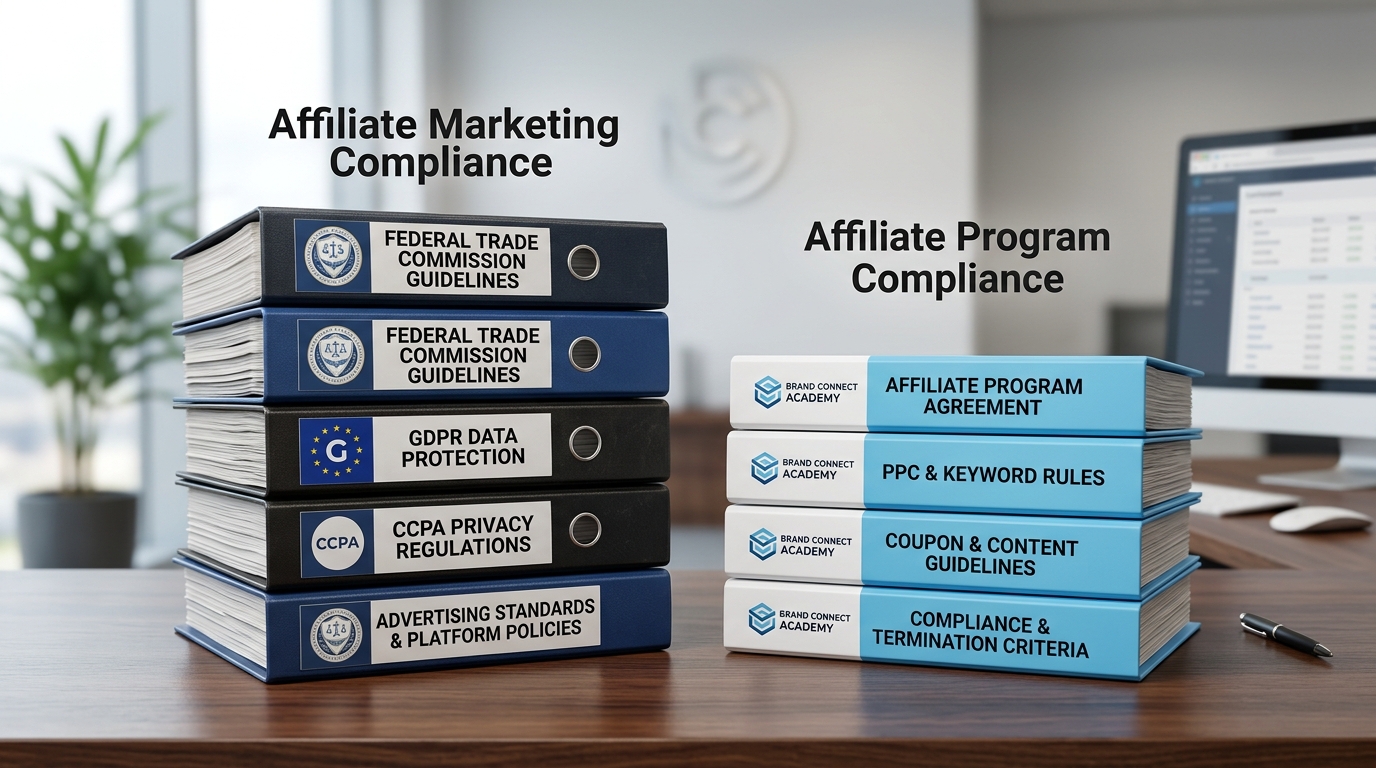
These two terms get used interchangeably, and that confusion costs brands real money.
Affiliate Marketing Compliance
This is broad ecosystem compliance. It covers the laws, regulations, and industry norms that apply to anyone doing affiliate marketing anywhere, FTC, GDPR, CCPA, platform policies, advertising standards. It is the universal baseline that exists whether you set it or not.
Affiliate Program Compliance
This is brand-specific rule enforcement. It covers the policies you set for your program, your PPC restrictions, coupon rules, content guidelines, and termination criteria. It is the layer that sits on top of the legal baseline.
| Dimension | Affiliate Marketing Compliance | Affiliate Program Compliance |
|---|---|---|
| Scope | Industry-wide laws and norms | Brand-specific policies |
| Set By | Regulators, platforms, courts | The brand or program manager |
| Examples | FTC disclosures, GDPR consent | No brand bidding, no coupon sites |
| Enforcement | Government, platform bans | Commission reversal, partner removal |
| Updates | Slowly, via regulation | Continuously, via program decisions |
A great program enforces both layers simultaneously. Most programs enforce neither well.
How Brands Keep Affiliates Compliant

This is where most resources stop. Real affiliate enforcement is what separates a program that looks compliant from one that actually is.
Manual Enforcement
The traditional approach is reactive: a brand manager spot-checks a handful of affiliates per quarter, reads through landing pages, runs a few branded search queries, and hopes nothing major is happening in the long tail.
The problems are obvious:
- Time-consuming - Reviewing partners by hand eats hours that should go into growth.
- Human error - Reviewers miss patterns, especially across channels they do not regularly monitor.
- Hard to scale - A program with 50 affiliates might be auditable by hand. A program with 500 or 5,000 is not.
Automated Affiliate Enforcement
Modern compliance operates as a continuous, automated system that watches every partner, every channel, and every conversion. The core capabilities are:
- Rule monitoring across paid search, social, email, and content channels.
- Attribution validation that catches cookie stuffing and last-click hijacking.
- Fraud detection that scores conversions in real time.
- Coupon misuse detection across browser extensions and public coupon sites.
- Commission reversals that fire automatically when a violation is confirmed.
- Violation tracking that builds a documented audit trail for every partner.
This is the layer where platforms like HeldSway earn their place in the stack, automating the monitoring, evidence collection, and enforcement workflows that no human team can sustain at scale.
Affiliate Agreement Compliance: What to Include in Contracts

Your contract is the legal foundation of every enforcement action you will ever take. Weak contracts produce weak programs. Strong affiliate agreement compliance - and affiliate contract compliance - starts with airtight clauses.
Disclosure Requirements
Spell out exactly what disclosure language is acceptable, where it must appear, and on which channels. Reference FTC and relevant regional guidelines explicitly so there is no ambiguity in court or in an audit.
Prohibited Traffic Sources
List every disallowed source: incentivized clicks, bot networks, cookie-stuffing methods, spam email, malware-bundled installs, and any others specific to your category.
Brand Term Restrictions
Define what counts as a brand term, list every variation and misspelling, and prohibit bidding, domain registration, and ad-copy use across all paid channels.
Coupon Usage Policies
State whether affiliates may publish codes, on which sites, and under what conditions. Explicitly prohibit browser-extension coupon injection and unauthorized aggregator sites.
Commission Reversal Terms
Define the conditions under which commissions can be reversed, chargebacks, returns, confirmed fraud, policy violations, and the timeframe in which reversals may occur.
Fraud Prevention Terms
Reserve the right to investigate, audit, and withhold payouts pending investigation. Define what evidence triggers an automatic reversal.
Termination Conditions
Spell out grounds for immediate termination, the notice process, and the handling of unpaid commissions upon termination.
Affiliate Agreement Monitoring: How to Monitor Partner Compliance

A signed contract that no one monitors is theater. Real affiliate agreement monitoring is a five-step operating cadence that runs continuously.
Step 1: Monitor Affiliate Traffic
Track inbound traffic by partner, by source, by device, and by geography. Sudden spikes, unusual geos, or traffic patterns that do not match a partner’s stated channels are early warning signs.
Step 2: Detect Attribution Abuse
Inspect the click path on every conversion. Look for stuffed cookies, last-click overrides on branded search, and short click-to-conversion windows that suggest coupon-extension hijacking.
Step 3: Validate Conversions
Run conversion data through fraud scoring, IP reputation, device fingerprint, behavior patterns, historical chargeback rates by partner. Hold suspicious conversions for human review before payout.
Step 4: Audit Promotional Methods
Crawl partner landing pages, scan social posts for required disclosures, check paid search results for branded bidding, and monitor coupon sites for unauthorized code distribution.
Step 5: Track Policy Violations
Maintain a per-partner violation history. First-time violations trigger a warning. Repeat violations escalate automatically through your enforcement policy.
This is the framework. HeldSway is designed to run all five steps as a single automated workflow, but the framework matters more than the tool.
Affiliate Rules Monitoring: How to Automate Compliance
Manual monitoring caps out at a few dozen partners. Automated affiliate rules monitoring is the only realistic path for a program of any meaningful size.
Compliance Monitoring Framework

A complete monitoring framework has six components. Each one closes a specific category of risk.
Tracking Compliance
Verify that tracking links are correctly implemented, cookies are dropping as expected, and there is no parameter tampering between click and conversion.
Coupon Validation
Detects when coupon codes appear on unauthorized sites, browser extensions, or aggregator platforms. Flag commissions tied to coupon traffic that violates program terms.
Attribution Integrity
Score every conversion on the credibility of its click path. Identify and reverse commissions where attribution was won by stuffing, hijacking, or fraudulent last-click manipulation.
Fraud Detection
Apply machine-learning models to conversion data to surface bots, click farms, identity-fabricated leads, and other coordinated fraud patterns.
Rule Enforcement
When a violation is confirmed, automatically trigger the appropriate action, warning, commission reversal, suspension, or termination, based on your enforcement policy.
Audit Logs
Every monitoring event, every detection, and every enforcement action is logged with timestamps, evidence, and the resulting decision. This is your defense if a partner disputes a reversal or a regulator asks for documentation.
Automation does not replace judgment. It eliminates the 95 percent of the work that does not require judgment, so your team can focus on the 5 percent that does.
Affiliate Policy Compliance Checklist (2026)

Use this affiliate policy compliance checklist as your quarterly audit. If you cannot tick every box, you have a gap.
Legal Compliance
- FTC disclosures standardized across all partners
- Privacy policies updated and linked from every promotional asset
- GDPR/CCPA consent mechanisms in place
Program Compliance
- Affiliate agreement signed by every active partner
- Coupon restrictions communicated and acknowledged
- Brand bidding rules published in the partner portal
Monitoring Compliance
- Conversion validation running on 100 percent of payouts
- Fraud monitoring covering all major traffic sources
- Policy enforcement automated where possible
Documentation
- Audit logs retained for at least 24 months
- Partner communication archived per partner
- Violation records kept with supporting evidence
Is Affiliate Marketing Illegal?

No, affiliate marketing is not illegal.
Affiliate marketing is legal when affiliates follow advertising, disclosure, and consumer protection laws. It becomes problematic when affiliates hide sponsorships, commit fraud, misuse trademarks, or mislead customers.
A wellness blogger who reviews a supplement, discloses the affiliate relationship clearly, and links honestly is operating well within the law. An affiliate who runs paid ads claiming “doctors hate this trick” linked to a fake news site is committing deceptive advertising, and both the affiliate and the brand can be held liable.
The legal line is not whether you use affiliate links. It is whether your audience is being deceived, your competitors are being undercut by trademark abuse, or consumer data is being collected without consent.
How to Build a Compliant Affiliate Marketing Program

If you are starting from zero or rebuilding an existing program, follow this seven-step sequence.
- Create affiliate policies. Document what partners can and cannot do, in plain language.
- Define affiliate marketing rules. Translate policies into specific, measurable rules by channel, content type, and geography.
- Draft compliance agreements. Convert your rules into enforceable contract clauses.
- Monitor affiliate activity. Set up tracking, traffic analysis, and content monitoring from day one, not after problems appear.
- Enforce violations. Build a tiered enforcement policy: warning, reversal, suspension, termination. Apply it consistently.
- Validate conversions. Score every conversion for fraud signals before paying it out. Hold suspicious ones for review.
- Automate compliance tracking. Manual oversight breaks at scale. Move to an automated monitoring platform before the wheels come off.
Programs that follow this sequence avoid the painful “compliance crisis and reset” cycle that catches up to most growing programs around the 100-partner mark.
Best Affiliate Marketing Compliance Tools
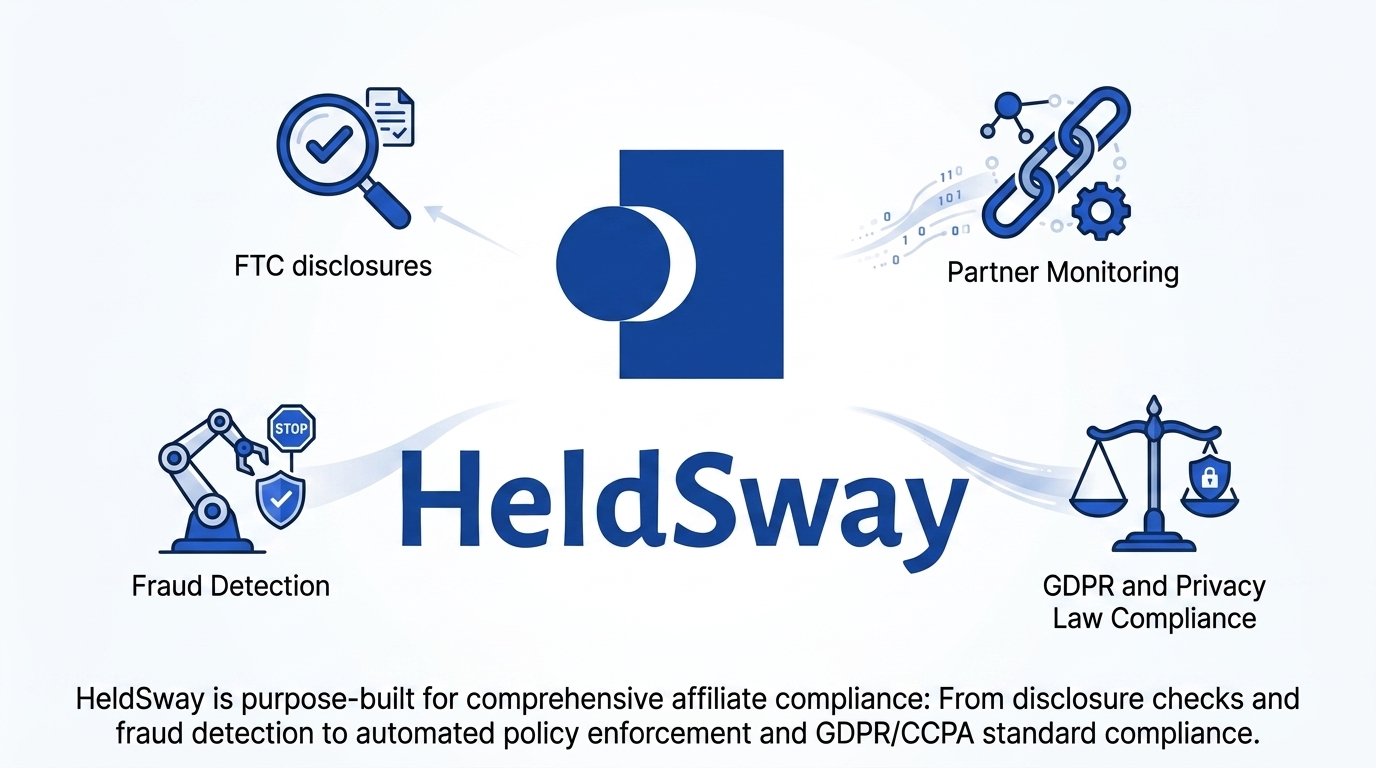
When choosing a compliance platform, evaluate three capabilities: monitoring depth, fraud detection accuracy, and attribution validation.
| Tool | Compliance Monitoring | Fraud Detection | Attribution Validation |
|---|---|---|---|
| HeldSway | ✓ | ✓ | ✓ |
| Impact | Limited | Partial | ✓ |
| Everflow | Partial | ✓ | ✓ |
| PartnerStack | Limited | Limited | Partial |
HeldSway is purpose-built for compliance and enforcement, the others are partnership platforms that bolt on compliance features. If compliance is your top concern, that distinction matters.
Final Thoughts

Affiliate marketing in 2026 rewards programs that treat compliance as a competitive advantage, not as overhead. The brands that monitor partner behavior, automate enforcement, validate attribution, and document everything end up with higher-quality partner rosters, cleaner conversion data, and zero regulatory drama.
The brands that do not are still leaking margin to fraud, still one screenshot away from an FTC complaint, and still fighting fires that smarter programs eliminated years ago.
Start with the framework in this guide. Audit your current program against the four pillars of affiliate marketing compliance. Close the gaps. Then automate everything you can, because manual compliance is a tax on growth, and you have better things to spend your team’s hours on.
Frequently Asked Questions
What is affiliate marketing compliance?
Affiliate marketing compliance is the practice of ensuring affiliate partnerships follow advertising laws, disclosure requirements, privacy regulations, program policies, and attribution standards. It covers legal compliance, brand-specific rules, tracking integrity, and enforcement against violations.
Why is affiliate marketing compliance important?
It protects brands from legal penalties under the FTC, GDPR, and CCPA; prevents revenue leakage from fraud and attribution abuse; safeguards brand reputation from misleading promotions; and improves program ROI by filtering for higher-quality partners.
How do brands monitor affiliate compliance?
Brands monitor compliance through traffic analysis, conversion validation, content audits, paid-search monitoring, coupon-site scanning, and automated fraud detection. Mature programs use dedicated compliance platforms to automate these checks at scale.
What are affiliate marketing rules?
Affiliate marketing rules are the policies governing how partners may promote a brand. They cover disclosures, PPC bidding restrictions, coupon distribution, content claims, trademark usage, social media practices, email promotions, and traffic quality standards.
What is affiliate enforcement?
Affiliate enforcement is the systematic process of detecting violations, documenting evidence, and taking action against non-compliant partners. Actions range from warnings and commission reversals to account suspension and termination.
Is affiliate marketing legal?
Yes. Affiliate marketing is legal when affiliates follow advertising, disclosure, and consumer protection laws. It becomes illegal when affiliates hide sponsorships, commit fraud, misuse trademarks, or mislead consumers, in which case both the affiliate and the brand can face regulatory action.
What happens when affiliates violate rules?
Consequences depend on the program's enforcement policy and the severity of the violation. Typical actions include a written warning for first-time minor violations, commission reversal for confirmed fraud, suspension pending investigation for serious violations, and permanent termination for repeat or egregious offenders.
How do affiliate agreements ensure compliance?
A well-drafted affiliate agreement defines disclosure requirements, prohibited traffic sources, brand-term restrictions, coupon policies, commission reversal terms, fraud prevention clauses, and termination conditions. It provides the legal foundation that makes enforcement actions defensible and consistent.
How do companies enforce affiliate program compliance?
Companies enforce compliance through continuous monitoring of partner activity, automated detection of policy violations, evidence collection through audit logs, tiered enforcement actions, and clear partner communication throughout the process. Automated platforms like HeldSway handle the monitoring and evidence collection so program managers can focus on judgment calls.