

Flat vs. Percentage vs. Recurring Commissions: Which Model Grows Your Program Faster?
Every merchant launches their partner program with the same question: how much should we pay?
Most brands look at their competitors, copy their rates, and hope for the best. This lazy approach is how programs fail before they start. Your commission model is not just a payout rate. It is the central financial engine of your program. It decides which partners will join, how they will promote you, and whether your program makes money or drains your bank account.
When you design affiliate commission structures, you choose between three main models: flat fees, percentages, and recurring payouts. A wrong choice can attract the wrong traffic, destroy your margins, or alienate the exact partners you need to grow. A direct consumer mattress brand cannot pay recurring commissions. A business software company will struggle to attract partners with a one-time flat fee.
To build the best affiliate commission structure, you need to understand the economics of each model. Here is an honest, detailed guide written from the perspective of an affiliate manager who has built, run, and salvaged programs across ecommerce, software, and services.
What Is an Affiliate Commission Structure?

An affiliate commission structure is the method a business uses to reward affiliates for driving sales, leads, or other desired actions. Rather than simply deciding how much to pay, it defines how commissions are calculated and when they’re earned.
Think of it as the incentive system behind your affiliate program. The structure you choose influences how motivated affiliates are to promote your products, which types of partners you attract, and whether your program remains profitable as it grows.
For example, an ecommerce store might pay affiliates 10% of every sale, while a SaaS company could offer $100 for each new customer or 30% recurring commission for as long as the customer stays subscribed. Although all three reward successful referrals, they encourage different behaviors and suit different business models.
The Three Most Common Affiliate Commission Structures
Most affiliate programs rely on one of these commission models:
| Commission Structure | How It Works | Best For |
|---|---|---|
| Flat | Pays a fixed amount for every successful referral, regardless of purchase value. | SaaS, lead generation, fixed-price services |
| Percentage | Pays affiliates a percentage of each sale. The commission increases as the order value increases. | Ecommerce, retail, marketplaces |
| Recurring | Pays affiliates repeatedly for subscription renewals or recurring payments. | SaaS, memberships, subscription businesses |
Some businesses stick with a single model, while others combine multiple structures to create a more competitive affiliate program. For example, a company might offer a one-time signup bonus along with recurring commissions for subscription renewals, giving affiliates both immediate rewards and long-term earning potential.
Why Your Commission Structure Matters
Your commission structure affects much more than affiliate payouts. It influences:
- Affiliate recruitment: Competitive commission models attract more high-quality partners.
- Promotion frequency: Affiliates are more likely to prioritize programs with earning potential that matches their audience and marketing efforts.
- Customer quality: The right incentives encourage affiliates to focus on customers who are more likely to convert and stay loyal.
- Program profitability: A well-balanced structure rewards affiliates generously while protecting your margins.
- Long-term growth: As your business scales, your commission model should remain sustainable without requiring constant adjustments.
In other words, your commission structure isn’t just a payment method. It’s a strategic tool that shapes the success of your entire affiliate program. Choosing the right model from the beginning can make it easier to recruit partners, increase conversions, and build a program that grows alongside your business.
The flat commission model: the upfront bounty
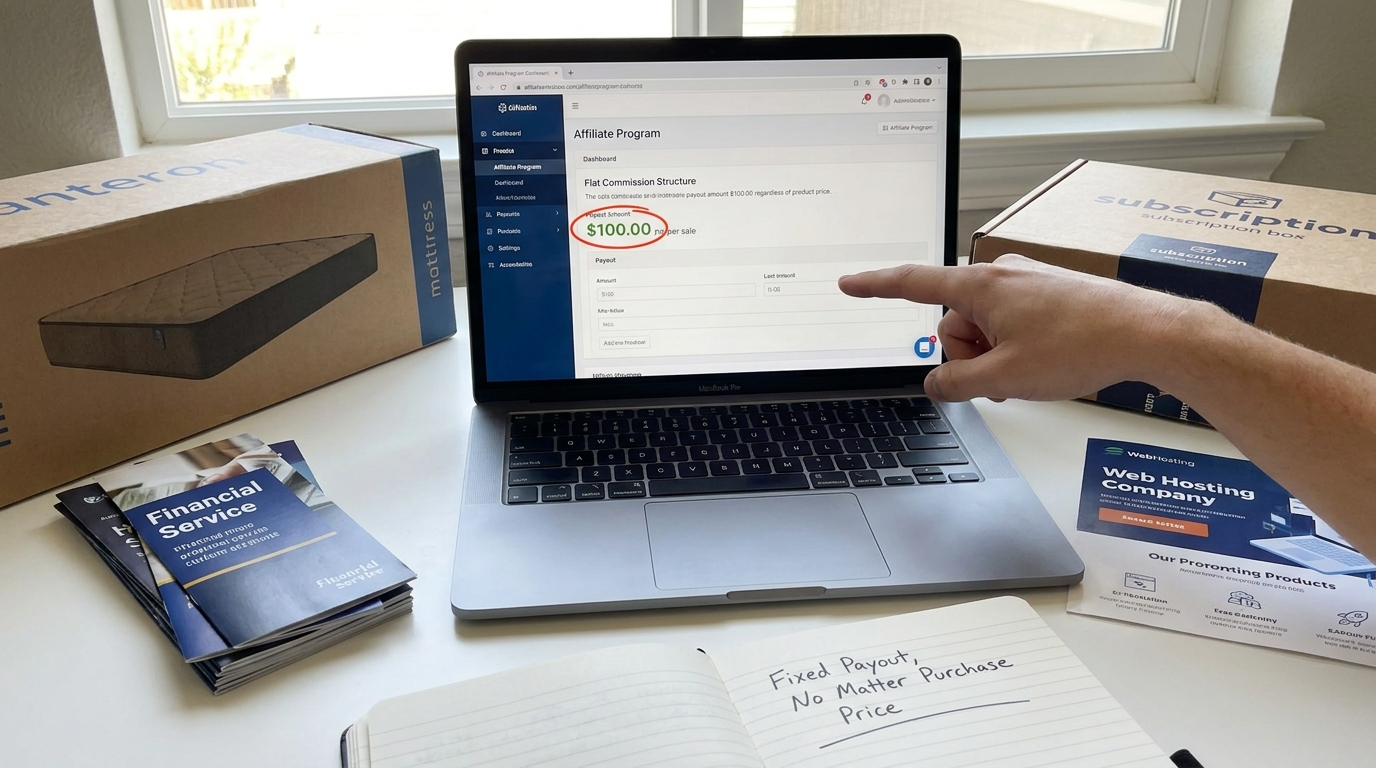
A flat commission affiliate program pays partners a fixed dollar amount for every sale, lead, or signup. The purchase price of the product does not matter. The customer could spend fifty dollars or five hundred dollars, but the partner receives the exact same payout.
This model is common in industries with fixed margins, high customer lifetime values, or single purchase products. You see it in web hosting, financial services, mattress companies, and subscription boxes.
How the economics work in practice
Let’s look at an example. A company sells mattress models for one thousand dollars. The cost of goods sold is three hundred dollars. Shipping and storage cost one hundred dollars. The company decides to pay a flat commission of one hundred and fifty dollars per sale.
The math for the brand is simple:
- Product Price: $1,000
- Cost of Goods Sold: $300
- Delivery Costs: $100
- Affiliate Commission: $150
- Net Margin: $450
The affiliate payout stays constant at $150. Even if a customer buys two mattresses, or adds sheets and pillows to the order, the partner gets $150. The brand keeps all the upside of larger orders.
How to calculate your maximum flat commission
To find the maximum amount you can pay, you must know your customer acquisition cost limits and average customer lifespan. For instance, if you sell a subscription box for forty dollars per month and the average customer stays for six months, the total revenue is two hundred and forty dollars.
If your gross margin is fifty percent, you have one hundred and twenty dollars to cover fulfillment, shipping, and support.
To make a profit, your marketing cost per customer must be lower than your margin. If you want a thirty percent profit margin (seventy two dollars), you can afford to spend forty eight dollars on customer acquisition. This forty eight dollars is your absolute ceiling for a flat commission. If you pay fifty dollars, you lose money on every signup.
Paid media buyers will analyze these numbers. If they know your ceiling, they can adjust their bidding strategies. For instance, if you pay forty dollars, they will aim for a cost per click of fifty cents and a conversion rate of at least one and a quarter percent. If their ad costs rise, they will ask for a higher flat fee or stop running ads for your brand.
Why flat commissions attract professional media buyers
Professional partners who buy paid ads (like search or social media traffic) need fast cash flow. They spend their own money to run ads, hoping to make a profit on the difference between their ad costs and your commission.
These partners prefer flat fees for two main reasons:
High payout values: Flat fees are often much higher than initial percentage payouts. A hosting company might sell a four dollar monthly plan but pay a flat eighty dollar commission.
Predictable numbers: If a media buyer knows they receive eighty dollars for every signup, they can calculate their target cost per acquisition. They know they can spend up to fifty dollars on ads to secure a conversion and make a clean thirty dollar profit.
If you pay a ten percent commission on a four dollar sale (forty cents), no paid media buyer will touch your program. They cannot run ads for forty cents. Flat fees bring in high volume partners who can scale your brand quickly through paid channels.
The dark side of the flat bounty
While flat fees drive rapid volume, they carry serious risks for your margins:
The cash flow bottleneck: If you pay a large flat fee upfront, you must wait months for the customer to become profitable. If a hosting brand pays eighty dollars on a four dollar subscription, it takes twenty months to recover that acquisition cost.
Low incentive for quality: Partners do not care how much the customer spends or how long they stay. They only care about the conversion event. This alignment gap can lead to high rates of early cancellations, refunds, and chargebacks.
Risk of fraud: High flat fees invite bad behavior. If you pay one hundred dollars for a fifty dollar product signup, bad actors will buy the product themselves using stolen credit cards, collect your commission, and vanish.
To run a flat commission affiliate program, you must monitor your refund rates daily. You also need a safety net, like holding payouts for forty five or sixty days to make sure the customer does not immediately refund the purchase.
Managing refund fraud and hold periods
High flat fees attract fraudulent signups. A bad actor will use a stolen credit card to buy a thirty dollar subscription, collect your eighty dollar flat commission, and disappear before the bank flags the stolen card.
To prevent this, you must set up clear safety rules in your terms:
Payout hold periods: Hold all commissions for sixty days. This gives banks and card holders enough time to file chargebacks or request refunds.
Minimum usage rules: For software or hosting, require the customer account to be active and show actual usage for at least thirty days before approving the commission.
Strict self referral rules: Block affiliates from buying products through their own links to get a discount.
If you do not automate these rules, you will spend hours matching transaction databases with affiliate accounts.
The percentage commission model: the revenue share standard

The percentage affiliate commission model pays partners a slice of the total order value. If a customer spends one hundred dollars and your commission rate is ten percent, the partner makes ten dollars. If the customer spends five hundred dollars, the partner makes fifty dollars.
This is the default setup for physical retail and direct to consumer stores. It is the dominant ecommerce affiliate commission model.
How the economics work in practice
Let’s look at an apparel brand. The average order value is eighty dollars. The average product gross margin is fifty percent. The brand pays a ten percent commission.
Here is the math:
- Average Order Value: $80
- Gross Margin (50%): $40
- Affiliate Payout (10%): $8
- Brand Net Margin: $32
If the partner convinces a customer to buy three shirts instead of one, raising the order value to one hundred and fifty dollars, the partner makes fifteen dollars. The brand keeps sixty dollars in margin after paying the affiliate.
Why percentage models protect your margins
For ecommerce and retail brands, the percentage commission is the safest choice:
Automatic margin safety: Your marketing costs scale directly with your sales. If you have a low margin product, you do not risk paying out more than you make. The payout automatically adjusts to the size of the basket.
Incentives are aligned: Partners want the customer to spend as much as possible. They will actively promote upsells, bundles, and higher tier products because their payout increases.
Easy return handling: If a customer returns one shirt out of a three shirt order, you can easily adjust the commission to match the kept items. Tracking systems handle partial returns on percentage sales much better than flat fees.
Niche bloggers, product review sites, and shopping influencers prefer this model because they can write a single product review, link to a store, and earn money on whatever the reader buys.
Managing coupons and discount codes in percentage models
Coupon sites often join percentage programs to capture commissions at the last second of the checkout process. A customer is ready to buy, sees a promo code box, searches Google for a coupon, clicks an affiliate link, and completes the purchase.
This does not bring in new customers. It simply steals your margin.
To prevent this, you must set up different commission rates for different partner types:
-
Content creators (bloggers, reviewers): 10% base rate.
-
Coupon and deal sites: 2% or 3% rate, or zero commission on orders that use generic sitewide promo codes.
-
Cashback portals: 5% rate to encourage repeat purchases without overpaying.
You can also set up rules that automatically reduce the commission if a customer uses a high discount code (like thirty percent off). If the cart value drops, the affiliate commission drops too, which helps keep your margin safe.
The limits of percentage payouts
While safe, percentage commissions have clear limits when you try to scale:
Low partner motivation on cheap items: If you sell twenty dollar t-shirts and pay a ten percent commission, your partners make two dollars per sale. They need to drive a massive volume to make any real money. They will often choose to promote higher priced competitors instead.
Complex return windows: Retail return periods are typically thirty to ninety days. You cannot pay commissions immediately because customers might return the goods. This delay means your partners must wait a long time to get paid, which can slow down their promotion efforts.
High competition: Because almost every online store uses this model, partners can easily compare rates. If your competitor pays twelve percent and you pay ten percent, you will lose the best partners unless you have a much higher conversion rate.
To make the percentage model work, you need to monitor your average order values and conversion rates. If your average order value is low, you must offer higher commission rates to keep partners interested.
The recurring commission model: the lifetime partnership

The recurring affiliate commission model pays partners a continuous commission for as long as the referred customer stays subscribed. This is the dominant model for SaaS affiliate commissions, membership sites, and subscription boxes.
Instead of a single payment, partners get a slice of the customer subscription fee every month or every year.
How the economics work in practice
Let’s look at a business software company that sells a subscription for one hundred dollars per month. The company pays a recurring commission of twenty percent.
- Monthly Subscription: $100
- Monthly Affiliate Payout: $20
- Average Customer Lifetime: 12 months
- Total Affiliate Payout: $240
- Total Revenue: $1,200
- Net Revenue after Commission: $960
If the customer stays for three years, the partner makes seven hundred and twenty dollars. If the customer cancels after two months, the partner makes forty dollars. The partner has a direct interest in sending customers who actually use the software and do not churn.
Why recurring models build passive income engines
For content creators, educators, and software reviewers, recurring payouts are the holy grail. They build a predictable stream of monthly revenue.
Long term loyalty: A partner who has built a monthly payout of five thousand dollars from your program is highly unlikely to switch to a competitor. They will defend your brand and update their content regularly to keep that income safe.
Focus on customer quality: Partners will explain how to use your product, create tutorials, and help their audience get value from the software. They know that if the customer succeeds, they get paid for years.
High customer lifetime value alignment: The brand only pays for active customers. If a customer churns, the commission stops. The brand does not carry the cash flow risk of paying a large CPA upfront for a customer who cancels in month two.
This model is the main reason why software programs grow so fast. The promise of passive income drives creators to build massive review sites, online courses, and comparison databases centered around recurring software products.
Capping recurring payouts vs. lifetime commitments
Many software brands are moving away from lifetime recurring payouts. Instead, they cap the commissions at twelve or twenty four months.
Let’s look at the math. A customer signs up for a team plan at two hundred dollars per month. The affiliate commission is twenty percent (forty dollars per month).
-
Lifetime commission (customer stays for 5 years): You pay two thousand four hundred dollars in commissions on a single referral.
-
Capped commission (12-month limit): You pay four hundred and eighty dollars total. The affiliate gets paid for the first year, and then you keep one hundred percent of the revenue.
Capping payouts helps protect your company valuation. Investors look at recurring commission liabilities when valuing software businesses. A company with a lifetime payout obligation has lower net margins and a lower valuation than one with capped payouts.
But capping payouts will reduce your appeal to top tier content partners. They want long term passive income. If you cap payouts, you must offer a higher percentage (like thirty percent for the first year) to make up for the loss of lifetime revenue.
The hidden traps of recurring payouts
Despite its popularity, the recurring model has several severe drawbacks:
Compounding liability: As your program grows, you build a massive monthly payroll of affiliate commissions. If you have partners who referred customers five years ago, you are still paying them twenty percent every single month. This can hurt your long term profit margins, especially if you want to sell the company or raise capital.
Slow start for paid media buyers: Paid search and social media ad buyers cannot fund their campaigns with monthly twenty dollar payouts. They need cash today to buy ads tomorrow. If you only offer recurring payouts, you will exclude these high volume partners from your program.
Administration overhead: Tracking upgrades, downgrades, churn, and account suspensions is incredibly difficult. If a customer upgrades from a fifty dollar plan to a two hundred dollar plan, the commission must adjust. If they stop paying for three weeks and then renew, the system must pause and resume payouts correctly.
Without a strong tracking platform, managing recurring commissions becomes a manual nightmare of spreadsheets and billing audits.
Direct comparison: which model wins under pressure?
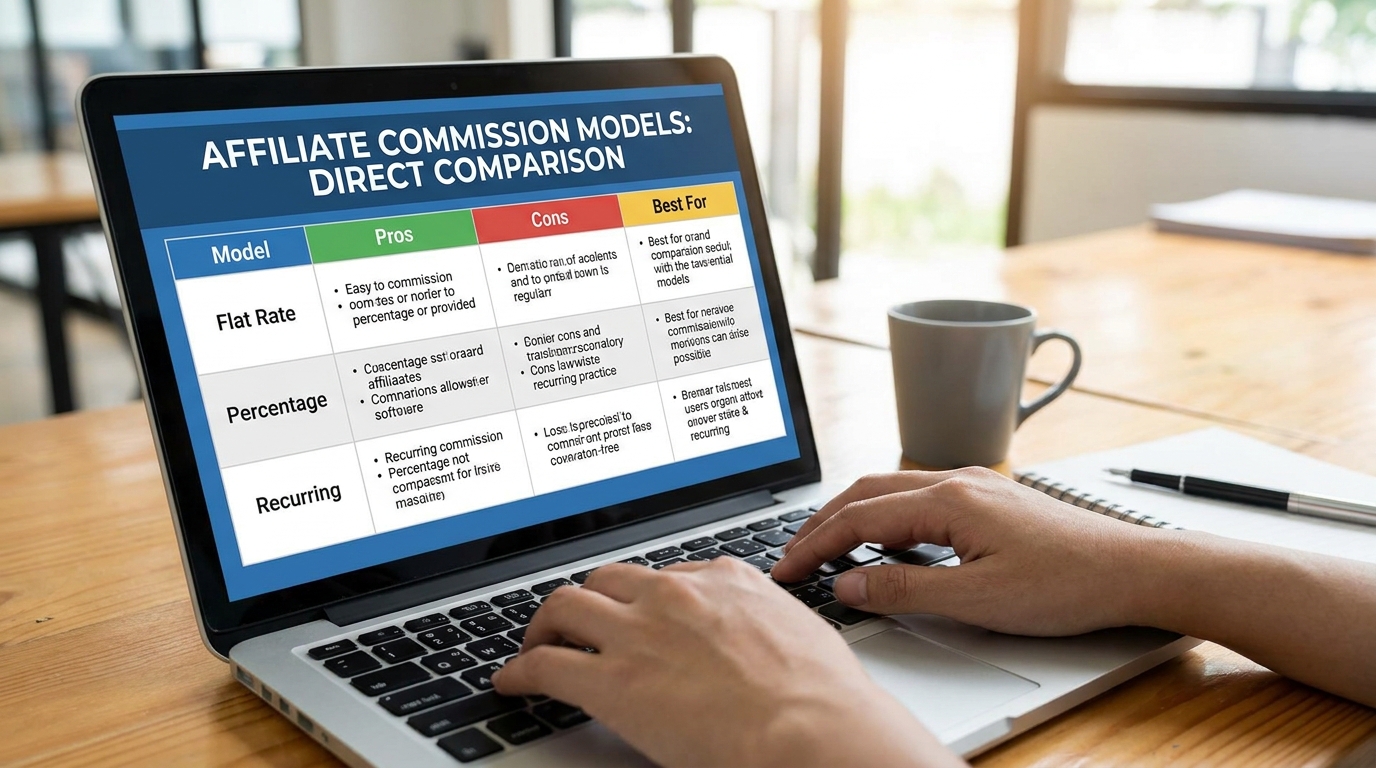
To choose the right commission setup, you must compare how these affiliate payout models perform across different business goals. Let’s look at the direct trade-offs.
| Performance Variable | Flat Commission | Percentage Commission | Recurring Commission |
|---|---|---|---|
| Partner Types Attracted | Media buyers, PPC specialists | Bloggers, influencers | Reviewers, course creators |
| Cash Flow Risk | High (pay upfront before profit) | Low (pay after order clears) | Very low (pay as revenue comes in) |
| Long Term Margin Risk | Low (fixed cost per sale) | Low (fixed cost per order) | High (lifetime margin drain) |
| Affiliate Churn Incentive | High (affiliate does not care) | Medium (affiliate wants big cart) | Low (affiliate wants retention) |
| Admin Complexity | Low (one payout per event) | Medium (returns, partial edits) | High (upgrades, downgrades, churn) |
Payout mechanics and math
Let’s look at how the different structures play out financially over twelve months. We will use a software product that costs one hundred dollars per month. The customer stays for exactly one year, spending a total of one thousand two hundred dollars.
Let’s compare three different payout designs:
- Design A: A flat commission of $150 upfront.
- Design B: A ten percent commission on all revenue ($120 total over one year).
- Design C: A twenty percent recurring monthly commission ($240 total over one year).
Under Design A, you pay $150 on day one. You lose money on the acquisition for the first two months. If the customer cancels in month three, you have paid $150 for $300 in revenue. If the customer stays for five years, you still only paid $150. This is great for long term value but risky for short term cash flow.
Under Design B, you pay ten percent on the first purchase and all future purchases. This is a common compromise. Over twelve months, you pay $120. Your margin is safe from day one, but the partner makes less than they would under a recurring model.
Under Design C, you pay twenty percent monthly. Over twelve months, you pay $240. The affiliate makes the most money, and they are highly motivated to keep the customer active. But you pay a heavy price in long term margin. If that customer stays for five years, you will pay one thousand two hundred dollars in commissions on a single referral.
The best choice depends on your capital. If you have venture capital or strong cash reserves, you can afford to pay high flat commissions upfront to buy market share. If you are bootstrapping, a percentage or recurring structure keeps your cash flow safe.
How different affiliate commission models affect partner motivation
.jpg)
Different partners look for different structures. If you choose the wrong model, you will attract the wrong partners:
Review websites and comparison portals: They prefer recurring commissions because they want to build long term income. They will write detailed comparisons of software tools and update them for years.
Instagram and YouTube influencers: They prefer percentage commissions. They show a product, link to a store, and expect their followers to buy a mix of items. They want a piece of the entire basket.
PPC search affiliates: They prefer flat commissions because they need cash to pay their daily Google ad bills.
If your program only offers recurring fees, search affiliates will ignore you. If you only offer flat fees, comparison sites will replace you with a recurring competitor as soon as their volume drops. Setting the correct affiliate compensation model is the only way to attract the right balance of these partners.
Looking for software that supports all three commission models?
Most affiliate platforms only support basic commission rules.
HeldSway lets you combine flat, percentage, recurring, tiered, product-specific, and custom affiliate commissions without custom development.
Hybrid commission structures: the best of all worlds

You do not have to choose just one model. Many of the fastest growing affiliate programs use hybrid structures to balance cash flow risk and partner motivation.
By combining elements, you can create a custom affiliate compensation model that fits your specific margins.
The flat fee plus recurring split
This setup is common in SaaS affiliate commissions. You pay a small flat fee upfront to help partners cover their initial costs, followed by a smaller recurring percentage to keep them motivated.
For example, a business tool might pay fifty dollars upfront, plus ten percent recurring.
This hybrid structure appeals to both paid media buyers and content creators. The paid media buyer gets enough cash to cover ad costs, while the content creator builds a small stream of passive income.
The percentage tier escalation
Instead of paying a flat percentage, you build tiers based on performance. This encourages partners to drive more volume to unlock higher rates.
- Tier 1: 10% commission for up to 10 sales per month
- Tier 2: 12% commission for 11 to 30 sales per month
- Tier 3: 15% commission for 31+ sales per month
Tiers are excellent for physical retail and ecommerce. They reward your top ten percent of partners who drive ninety percent of your revenue, without raising marketing costs for low performing partners.
The flat fee plus percentage bonus
For high ticket ecommerce products, you can combine a flat fee with a percentage. This works well for premium home goods or consumer electronics.
For example, you might pay a flat twenty dollars per order, plus five percent of the total basket value. This makes sure the affiliate makes a decent baseline commission even on small orders, while giving them a reason to encourage larger purchases.
Affiliate program commission examples in action
To understand how these designs look in the real world, let’s examine three specific affiliate program commission examples from different industries:
Bluehost (Web Hosting): Uses a flat commission affiliate program model. They pay a flat sixty five dollars per referral, regardless of the hosting plan selected. This high flat fee attracts paid search buyers and bloggers who can write hosting reviews and fund their traffic.
Amazon Associates (Ecommerce): Uses a percentage affiliate commission model. They pay between one percent and ten percent depending on the product category. Because their average order value is low, they rely on massive search volume and product recommendation lists.
ActiveCampaign (SaaS): Uses a recurring affiliate commission model. They pay a base of twenty percent recurring, which can rise to thirty percent as the partner drives more volume. This structure motivates consultants and agencies to recommend the software and help their clients use it long term.
These examples show that the best affiliate commission structure is not a single standard. It is a custom choice that fits your product’s margin and customer lifespan. Looking at other affiliate commission models can help you find a custom path that fits your budget.
The operational reality: tracking, auditing, and HeldSway

Choosing your commission rates is only half the battle. The real pain starts when you try to run the program.
Affiliate tracking is simple when every sale is clean, paid in full, and never returned. But that is not how real business works. In the real world, you deal with a constant flow of transaction updates:
- A customer buys a jacket, returns it three days later, and asks for a refund.
- A subscriber upgrades from the basic plan to the team plan, then downgrades two weeks later.
- A user disputes a charge on their credit card, triggering a chargeback fee.
- An affiliate signs up using a fake account to buy their own product at a discount.
If you track these events manually on spreadsheets, you will waste hours every week. Your partners will get paid incorrect amounts. They will lose trust in your program, stop promoting you, and leave.
This operational headache is why we built HeldSway.
HeldSway is a partner tracking and management platform designed to handle complex, hybrid, and recurring commission models without manual work. It connects directly with your payment processor and subscription billing software.
When a billing event happens, HeldSway handles it automatically:
Automatic return adjustment: If a customer returns a product, HeldSway automatically calculates the change and deducts the correct amount from the partner’s pending balance.
Subscription state sync: When a user upgrades or downgrades their plan, HeldSway updates the recurring commission rate in real time.
Fraud detection: The system flags self referrals, duplicate IPs, and suspicious refund patterns before you pay out commissions.
Auto generated self billing invoices: HeldSway generates compliance ready billing documents for your finance team, saving hours of manual bookkeeping.
By automating these processes, you can focus on building relationships with your partners rather than auditing spreadsheets.
Ready to Launch a Hybrid Affiliate Program?
Hybrid commission structures can increase affiliate engagement, but managing flat, percentage, recurring, and tiered payouts manually quickly becomes overwhelming.
Changing your commission model without killing your program

As your business grows, your financial needs will change. You might realize that your twenty percent recurring payout is unsustainable. Or you might need to shift from flat fees to percentages to protect your cash flow.
Changing your commission structure is a delicate process. If you handle it poorly, your best partners will feel betrayed. They will take down their reviews, direct their traffic to your competitors, and warn other affiliates to avoid your brand.
Here is a guide to changing your commission structure without causing a revolt.
Grandfathering existing partners
The golden rule of commission changes is simple: do not touch old referrals.
If a partner referred a customer under a recurring agreement, you must honor that agreement. If you retroactively cut their pay on historical sales, you destroy your brand reputation.
Instead, apply the new commission structure only to new referrals driven after a specific date. This approach is called grandfathering. It shows your partners that you respect their past contributions, even as you adjust your business model for the future.
Give plenty of warning
Never announce a commission change on the day it takes effect. Give your partners at least thirty days, preferably sixty days, of warning.
Send a clear email explaining:
- What is changing (e.g., shifting from 20% recurring to 15% recurring).
- Why it is changing (e.g., to fund better product development or customer support, which will help them convert more traffic).
- The exact date the change takes effect.
- How it affects their existing balance (reassure them that old commissions are safe).
This transparency helps build trust. Partners might not like the lower rates, but they will appreciate the notice, which allows them to adjust their ad spend or content plans.
Offer a performance incentive
If you must lower your base commission rate, offer a path for high performers to keep their old rates.
For instance, if you cut your base rate from twenty percent to fifteen percent, announce that anyone driving more than twenty sales per month will remain at twenty percent.
This softens the blow for your most important partners. It also encourages mid tier partners to work harder to reach the higher performance tier.
How Top Brands Structure Their Affiliate Commissions

There’s no single commission model that every successful affiliate program follows. Instead, leading brands design their commission structures around their business model, customer lifetime value (LTV), and growth strategy.
Some prioritize predictable customer acquisition costs, while others focus on long-term retention or increasing average order value. Understanding why they chose a particular commission structure can help you make better decisions for your own affiliate program.
Let’s look at a few well-known examples.
Shopify: Recurring Revenue Drives the Strategy
As a subscription-based ecommerce platform, Shopify has historically structured its affiliate program around the long-term value of new merchants rather than one-time purchases. While its commission terms have evolved over the years, the underlying strategy remains consistent: reward affiliates for referring high-quality businesses that are likely to become long-term customers.
Why it works:
- High customer lifetime value supports generous payouts.
- Affiliates are encouraged to target entrepreneurs who are serious about starting or growing a business.
- The commission structure aligns with Shopify’s subscription-based revenue model.
Takeaway: If your customers generate recurring revenue, your affiliate rewards should reflect that long-term value instead of focusing only on the initial sale.
Amazon Associates: Percentage Commissions at Scale
Amazon Associates is one of the world’s largest affiliate programs, using a percentage-based commission model across product categories.
Rather than paying a fixed amount per referral, affiliates earn a percentage of qualifying purchases. Because Amazon sells millions of products with different price points, percentage commissions provide a scalable and flexible solution.
Why it works:
- Works across a massive product catalog.
- Rewards affiliates more for higher-value purchases.
- Automatically scales as order values change.
Takeaway: Percentage commissions are often the most practical option for ecommerce businesses with diverse product catalogs.
HubSpot: High Rewards for High-Value Customers
HubSpot serves businesses with products that often generate significant long-term revenue. Instead of optimizing for volume alone, its affiliate program is designed to reward partners who refer qualified customers likely to invest in premium software.
Why it works:
- Customer lifetime value is substantially higher than the initial subscription.
- The program attracts affiliates capable of educating and nurturing business buyers.
- Higher payouts help justify the longer sales cycle.
Takeaway: If your product has a higher price point or requires more consideration before purchase, a more generous commission structure can attract experienced affiliates who are willing to invest the time to promote it effectively.
Canva: Simplicity Encourages Adoption
Canva has grown by making design accessible, and its affiliate experience reflects that same philosophy. Its commission structure is straightforward, making it easy for creators, educators, and marketers to understand what they can earn.
Why it works:
- Clear commission rules reduce friction during signup.
- The program appeals to a broad range of affiliates.
- Simplicity encourages more people to participate.
Takeaway: Even a competitive commission won’t perform well if affiliates struggle to understand how they get paid.
ConvertKit: Built Around Creator Success
As an email marketing platform designed for creators, ConvertKit has long recognized that many of its affiliates are content creators themselves. Its affiliate program rewards partners who consistently introduce new customers who remain active over time.
Why it works:
- Aligns affiliate earnings with recurring customer revenue.
- Encourages affiliates to create evergreen content.
- Supports long-term partnerships instead of one-time promotions.
Takeaway: If your audience naturally creates educational or evergreen content, recurring commissions can motivate affiliates to keep recommending your product long after their initial promotion.
What These Brands Have in Common

Although these companies use different commission structures, they share several important principles:
- They align commissions with their revenue model. Subscription businesses often favor recurring rewards, while ecommerce brands typically use percentage-based commissions.
- They consider customer lifetime value. Businesses with higher LTV can often afford more competitive affiliate incentives.
- They keep their programs easy to understand. Clear commission rules build trust and reduce hesitation among potential affiliates.
- They review and evolve their programs. Successful affiliate programs aren’t static. Commission structures are adjusted as products, pricing, and business goals change.
The Lesson for Your Business

One of the biggest mistakes businesses make is copying another company’s commission structure without understanding the reasoning behind it.
A commission model that works for a global ecommerce marketplace may not work for a growing SaaS startup. Likewise, a recurring commission designed for subscription software may not make sense for a business selling one-time physical products.
Instead of asking, “What commission structure do the biggest brands use?”, ask:
“Which commission structure best matches how my business earns revenue and the type of affiliates I want to attract?”
That’s the question that leads to a sustainable, scalable affiliate program.
The good news is that you don’t have to lock yourself into one approach forever. With a flexible affiliate management platform like HeldSway, you can test different commission structures, introduce performance-based incentives, and refine your strategy as your program grows, all without rebuilding your affiliate program from scratch.
How to Choose the Right Affiliate Commission Structure for Your Business

If you’ve made it this far, you’ve probably realized there isn’t a universal “best” commission model. The right choice depends on how your business generates revenue, what your customers are worth over time, and the type of affiliates you want to attract.
Instead of asking, “Should I use flat, percentage, or recurring commissions?”, ask a better question:
“Which commission structure creates the strongest incentive for affiliates while remaining profitable for my business?”
Use the following framework to make an informed decision.
1. Start with Your Business Model
Your revenue model is one of the strongest indicators of which commission structure will work best.
| Business Type | Recommended Structure | Why It Works |
|---|---|---|
| SaaS | Recurring or Flat + Recurring | Rewards long-term subscriptions and customer retention |
| Ecommerce | Percentage | Scales naturally with different order values |
| Membership Site | Recurring | Aligns affiliate rewards with recurring revenue |
| Online Course | Flat or Percentage | Works well for one-time purchases |
| Agency or Service Business | Flat | Predictable payouts for high-value referrals |
| Marketplace | Percentage or Hybrid | Supports multiple sellers and product categories |
While these are good starting points, don’t treat them as strict rules. Your pricing, margins, and customer behavior should always guide the final decision.
2. Calculate Your Customer Lifetime Value (LTV)
Before deciding what to pay affiliates, understand what a new customer is actually worth.
Suppose:
- Average monthly subscription: $75
- Average customer lifespan: 18 months
Your average customer lifetime value is approximately $1,350 before expenses.
With that information, paying a higher recurring commission may make sense because the long-term revenue can support it.
On the other hand, if customers typically make a single $60 purchase and never return, a recurring commission wouldn’t be appropriate.
Rule of thumb: Never base commission decisions solely on the first transaction if your customers generate ongoing revenue.
3. Know Your Profit Margins
Revenue and profit aren’t the same.
Two businesses selling products for $100 may have completely different margins.
For example:
| Product | Selling Price | Profit Margin |
|---|---|---|
| Digital Course | $100 | 80% |
| Physical Product | $100 | 25% |
The digital course can typically support a much higher affiliate commission than the physical product.
Always calculate commissions using sustainable profit margins rather than sales revenue alone.
4. Consider the Type of Affiliates You Want to Attract
Different commission models appeal to different affiliate audiences.
| Affiliate Type | What They Often Value |
|---|---|
| Bloggers | Recurring income and evergreen content opportunities |
| Influencers | Fast, easy-to-understand payouts |
| Paid Media Affiliates | Higher upfront commissions to recover ad spend |
| Review Sites | Competitive earnings and high conversion rates |
| Industry Partners | Long-term relationships and custom commission terms |
Understanding your ideal affiliate profile helps you design incentives they’ll actually find attractive.
5. Decide What Behavior You Want to Reward
Your commission structure should encourage the outcomes that matter most to your business.
Ask yourself:
Want more new customers quickly?
A flat commission can create a strong incentive for rapid customer acquisition.
Want affiliates to promote premium products?
A percentage commission rewards larger purchases.
Want higher customer retention?
Recurring commissions encourage affiliates to refer customers who are likely to remain active.
The best commission structures don’t just reward conversions, they reinforce the behaviors that support your growth strategy.
6. Leave Room to Experiment
Your first commission model shouldn’t be permanent.
As your affiliate program grows, you’ll learn:
- Which affiliates generate the most revenue
- Which products convert best
- Which commission models drive the highest ROI
- Where incentives can be improved
Businesses that regularly test and optimize their commission structures often outperform those that leave their programs unchanged for years.
A Simple Decision Checklist
Before launching your affiliate program, make sure you can answer yes to most of these questions:
- Do I understand my customer lifetime value?
- Have I calculated sustainable commission rates based on profit margins?
- Does the commission structure align with my business model?
- Will affiliates easily understand how they’re paid?
- Does the payout motivate the type of affiliates I want to recruit?
- Can I adjust the commission structure as my business grows?
If the answer to several of these is no, it’s worth revisiting your strategy before recruiting affiliates.
Why Flexibility Matters as Your Program Grows

Very few affiliate programs keep the exact same commission structure forever.
As you launch new products, expand into new markets, or attract different types of affiliates, your commission strategy should evolve too.
That’s why flexibility is just as important as choosing the right model today.
With HeldSway, you aren’t limited to a single payout structure. You can create flat, percentage-based, recurring, tiered, product-specific, and affiliate-specific commission rules, then refine them as you gather performance data. Instead of rebuilding your affiliate program every time your business changes, you can adapt your commission strategy with just a few updates.
The most successful affiliate programs aren’t built around one “perfect” commission model. They’re built around continuous optimization, testing, and aligning incentives with business growth.
Conclusion
There is no single best affiliate commission structure. The right choice depends on your margins, your cash flow, and the type of partners you want to attract.
- Choose flat commissions if you have high margin, single purchase products and want to attract professional media buyers who can scale your volume quickly.
- Choose percentage commissions if you run an ecommerce store with variable basket sizes and want to protect your margins from day one.
- Choose recurring commissions if you sell subscription software or services and want to build long term loyalty with content creators and educators.
Whichever model you choose, make sure you have the operational systems in place to manage it. A complex commission model is useless if you cannot track it accurately. Use tools like HeldSway to automate the tracking, return management, and payouts, so you can spend your time growing your partner network.
Frequently Asked Questions
Can different affiliates receive different commission rates?
Yes. Many businesses reward top-performing affiliates with custom commission rates based on factors such as:
- Monthly sales volume
- Audience quality
- Strategic partnerships
- Long-term performance
- Exclusive promotional agreements
This approach helps retain your most valuable partners while encouraging others to increase their performance.
Should commission rates vary by product?
In many cases, yes.
Products with higher profit margins can often support larger commissions, while lower-margin products may require more conservative payouts.
Offering product-specific commission rules helps balance affiliate incentives with profitability.
How often should I review my commission structure?
Review your affiliate program at least once or twice a year, or sooner if you experience significant changes such as:
- Launching new products
- Changing pricing
- Expanding into new markets
- Improving customer retention
- Attracting different types of affiliates
Regular optimization helps ensure your commission structure remains competitive and sustainable.
What features should affiliate software include for commission management?
Look for affiliate management software that supports:
- Flat commissions
- Percentage commissions
- Recurring commissions
- Tiered rewards
- Product-specific commission rules
- Custom affiliate rates
- Automated commission calculations
- Transparent reporting and payout tracking
These features make it easier to scale your affiliate program without increasing administrative work.